
I. Choose the word/ phrase/ sentence (A, B, C or D) that best fits the space in each sentences or best answers the question. ⇱
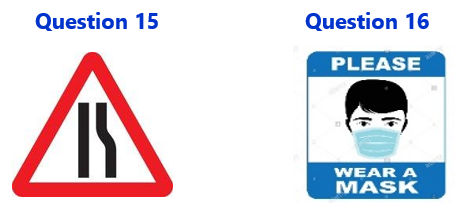
II. Look at the signs. Choose the best answer (A, B, C or D) for the question 15 and 16. ⇱
III. Read the following passage. Decide if the statements from 17 to 20 are True or False, and choose the correct answers (A, B, C or D) for question 21 and 22. ⇱
NASA's Mars Global Surveyor has orbited the planet since March 1999 on a mission to map and study the planet's entire surface. The long-term mission has produced particular insights into the dynamic planet's changing seasons and shifting weather, including its infamous dust storms. Perhaps the most famous of all Martian missions is that of the Mars exploration rovers Spirit and Opportunity. These two rovers reached opposite sides of Mars in January 2004 and have proceeded to explore the planet far more extensively than previous missions. The rovers have covered several miles and returned more than 100,000 high-resolution images. Probing soil and rocks, they have also used their fully equipped lab modules to conduct robotic field geology tests on the Martian surface and even below it. Many future Mars missions are already in development and will take place long before any human visits the planet. Scientists hope that robotic craft can delve far beneath the Martian surface to return data, and possible samples, of the planet's geology. Such missions could even find signs of the water, and possible life, that may lie hidden beneath the planet's forbidding exterior.
IV. Choose the word (A, B, C or D) that best fits the blanks space in the following passage. ⇱
Hurricanes are the most violent storms on Earth. People call these storms by other names, such as typhoons or cyclones, ___(23)___ on where they occur. The scientific term for all these storms is tropical cyclone. Only tropical cyclones that form over the Atlantic Ocean or eastern Pacific Ocean are ___(24)___ "hurricanes." Tropical cyclones are like giant engines that use warm, moist air as fuel. That is why they form only over warm ___(25)___ waters near the equator. The warm, moist air over the ocean rises upward from near the surface. Because this air moves up and away from the surface, there is less air left near the surface. Another way to say the same thing is that the warm air rises, causing an area of lower air ___(26)___ below. Air from surrounding areas with higher air pressure pushes into the low-pressure area. Then that "new" air becomes warm and moist and rises, too. As the warm air continues to rise, the surrounding air swirls in to ___(27)___ its place. As the warmed, moist air rises and cools off, the water in the air forms clouds. The ___(28)___ system of clouds and wind spins and grows, fed by the ocean's heat and water evaporating from the surface.