
I. Choose the word/ phrase/ sentence (A, B, C or D) that best fits the space in each sentences or best answers the question. ⇱
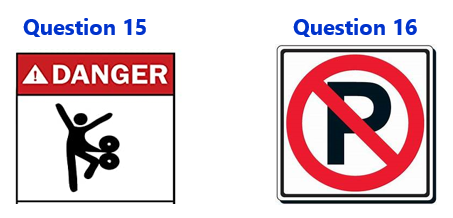
II. Look at the signs. Choose the best answer (A, B, C or D) for the question 15 and 16. ⇱
III. Read the following passage. Decide if the statements from 17 to 20 are True or False, and choose the correct answers (A, B, C or D) for question 21 and 22. ⇱
Everyone wants to reduce pollution. But the pollution problem is as complicated as it is serious. It is complicated because much pollution is caused by things that benefit people. For example, exhaust from automobiles causes a large percentage of all air pollution. But the automobile provides transportation for millions of people. Factories discharge much of material that pollutes air and water, but factories give employment to a large number of people.
Thus, to end or greatly reduce pollution immediately, people would have to stop using many things that benefit them. Most of the people do not want to do that, of course. But pollution can be gradually reduced in several ways. Scientists and engineers can work to find ways to lessen the amount of pollution that such things as automobiles and factories cause. Governments can pass and enforce laws that require businesses and traffic to stop, or cut down on certain polluting activities.
IV. Choose the word (A, B, C or D) that best fits the blanks space in the following passage. ⇱
Hurricanes are the most violent storms on Earth. People call these storms by other names, such as typhoons or cyclones, ___(23)___ on where they occur. The scientific term for all these storms is tropical cyclone. Only tropical cyclones that form over the Atlantic Ocean or eastern Pacific Ocean are ___(24)___ "hurricanes."
Whatever they are called, tropical cyclones all form the same way.
Tropical cyclones are like giant engines that use warm, moist air as fuel. That is why they form only over warm ___(25)___ waters near the equator. The warm, moist air over the ocean rises upward from near the surface. Because this air moves up and away from the surface, there is less air left near the surface. Another way to say the same thing is that the warm air rises, causing an area of lower air ___(26)___ below.
Air from surrounding areas with higher air pressure pushes in to the low pressure area. Then that "new" air becomes warm and moist and rises, too. As the warm air continues to rise, the surrounding air swirls in to ___(27)___ its place. As the warmed, moist air rises and cools off, the water in the air forms clouds. The ___(28)___ system of clouds and wind spins and grows, fed by the ocean's heat and water evaporating from the surface.