I. PRONUNCIATION ⇱
II. Choose the answer (A, B, C or D) that best fits the space in each question. ⇱
Question 14. Mary is talking to David, who has just helped her with her luggage.
Mary: “_________” David: “It’s my pleasure.”
III. Look at each sign or notice. Choose the best answer (A, B, C or D) that matches its meaning. ⇱


IV. Choose the word (A, B, C or D) that best fits each blank space in the following passage. ⇱
Earth's Moon is the brightest and largest object (17) _________ our night sky. The Moon makes Earth a more livable planet by moderating our home planet's wobble on its axis, leading to a relatively stable climate. It also causes tides, (18) _________ a rhythm that has guided humans for thousands of years. The Moon was likely formed after a Mars-sized body collided with Earth several billion years ago. Earth's only natural satellite (19) _________ "the Moon" because people didn't know other moons existed until Galileo Galilei discovered four moons orbiting Jupiter in 1610. In Latin, the Moon was called Luna, (20) _________ is the main adjective for all things Moon-related: lunar. (21) _________ Earth, the Moon has a day side and a night side, which change as the Moon rotates. The Sun always illuminates half of the Moon while the other half remains (22) _________.
V. Read the following and do as directed. ⇱
Born in Marton, near Middlesborough, Captain James Cook would go on to become one of the most famous explorers in British maritime history.
Indeed, young James’ childhood was nothing remarkable, and following his rudimentary education, Cook became an apprentice to William Sanderson, a local grocer. After 18 months working next to Staithes’ busy harbor, James felt the calling of the sea. Not wanting to stand in the young man’s way, he introduced Cook to his friend, John Walker, a ship owner from Whitby, who took him on as an apprentice seaman.
Cook lived in the Walker family house in Whitby and went to school with the other apprentices in the town. Cook worked hard and was soon serving on one of Walkers’ “cats”, the Freelove. Cats were hardy ships, built in Whitby to take coal down the coast to London. Cook was a quick learner and rapidly established himself as one of the most promising apprentices in Walker’s care.
In 1750, Cook’s apprenticeship with the Walkers ended, though he carried on working for them as a seaman. As always with Cook, it wasn’t long before he was promoted, and in 1755, he was offered the command of the Friendship, a cat he was familiar with. For many, this would have been the realization of an ambition, and they would have grasped the chance with both hands. Cook, however, wanted more than to spend his remaining years sailing in coastal waters in poor weather, so he politely turned down the Walkers’ offer and joined the Royal Navy.
a. Decide whether the following sentences are True or False:
b. Choose the correct answer to each question:
VI. Supply the correct form of the word given in each sentence. ⇱
VII. Choose the correct letter A,B,C or D to indicate the correct arrangement of the sentences to make a meaningful paragraph/letter in each of the following questions. ⇱
Question 35.
a. The city has bad traffic conditions in monsoon which makes it difficult for employees to reach office on time.
b. Thus, the office timings have been changed from 10:30AM to 6:30PM.
c. This is to inform you that the entire team at Top Management has decided to revise the office timings for the entire monsoon season.
d. This will be in effect from tomorrow, 25th of July.
e. This decision has been made in consideration of all the employees travelling from farther distance to office daily.
Question 36.
a. I understand that it is against the policy of our school.
b. This is to write to you that I am sincerely sorry for taking a week off without prior notice.
c. I went on a family trip which was a sudden plan.
d. I am ready to pay any punishment in return, please forgive me.
e. That is why I couldn’t inform or ask for leave in advance.
VIII. Rewrite each of the following sentences in another way so that it means almost the same as the sentence printed before it. ⇱
Question 37. I will go by car so that I can take more luggage.
> > In (37) car.
Question 38. In my opinion, you shouldn’t buy that laptop. (Use conditionals)
> > If (38) that laptop.
Question 39. I am typing so slowly.
> > I wish (39) .
Question 40. This building is the city’s public library. It was built 100 years ago. (Use relative clause)
> > This building, (40) library.
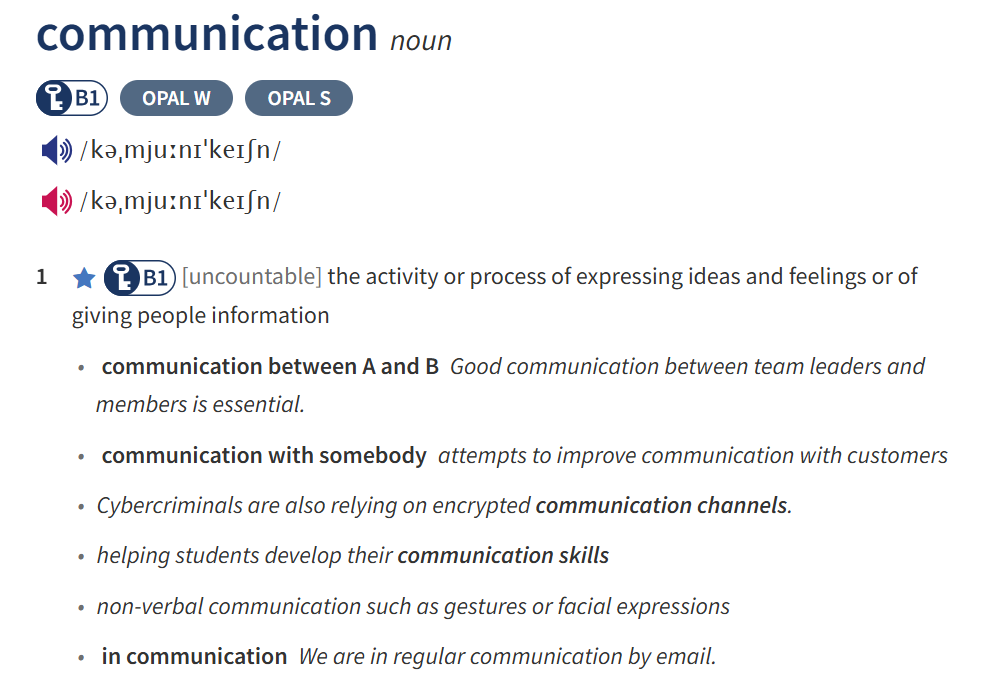
IX. Look at the entry of the word “communication” in a dictionary. Use what you can get from the entry to complete the sentences with two or three words. ⇱