Mark the letter A, B, C, or D on your answer sheet to indicate the word whose underlined part differs from the other three in pronunciation. ⇱
Mark the letter A, B, C, or D on your answer sheet to indicate the word that differs from the other three in the position of primary stress. ⇱
Mark the letter A, B, C, or D on your answer sheet to indicate the correct answer to each of the following questions. ⇱
ANNOUNCEMENT OF SCHOOL GREEN CLUB
Are you ___(13)___ about sustainability and protecting our planet?
Join us for our first project this Sunday on May of 15th.
Hundreds trees ___(14)___ along Sweet Road in the morning and we also will clean ___(15)___ the river bank in the afternoon.
___(16)___ you need more information, please contact Mr. Trung via zalo 093344556.
Put the sentences (a-c) in the correct order, then fill in the blank to make a logical text. ⇱
It is important to save the environment for the survival of the planet and the living beings in it. ______
a. Finally, it makes our planet a better place to live for future generations.
b. Moreover, by saving the environment, we are protecting our ecosystem and other natural resources.
c . Firstly, when we protect the environment, we are saving ourselves from the problems that will arise in the future.
d. In conclusion, it is vital to preserve and protect life on Earth.
Mark the letter A, B, C, or D on your answer sheet to indicate the correct option that best fits each of the numbered blanks from 19 to 24. ⇱
Notting Hill Carnival is held in London each August Bank Holiday, and is the largest and most colourful street ___(19)___ in Britain. The festival celebrates the traditions of the British black community ___(20)___ emigrated to Great Britain from the West Indies in the 1950s. They brought with them the Caribbean idea of “carnival”, with processions, colourful costumes, steel bands and street dancing. Preparations for the carnival begin many months beforehand. Costumes have to be made, and floats built, ___(21)___ for the street procession. Steel bands practise traditional Caribbean music on instruments made from old oil drums. Shortly before the festival, the streets ___(22)___ with red, green and yellow streamers, and amplifiers are set in place, to carry the rhythmic sounds over the roar of the London traffic. The carnival___(23)___ for three days, and is full of music and colour. Processions of floats, steel and brass bands, and dancers in exotic costumes make their way through the narrow London streets, ___(24)___ by thousands of people. The streets are lined with stalls selling tropical fruits, such as fresh pineapple, water melons and mangoes everybody dances -black and white, young and old- even the policemen on duty take part in the fun. For these three days in August, a little Caribbean magic touches the streets of London.
Mark the letter A, B, C, or D on your answer sheet to indicate the sentence that is closest in meaning to the original sentence in each of the following questions. ⇱
National parks should be established to save animals and plants.
Mark the letter A, B, C, or D on your answer sheet to indicate the sentence that is made from the given cues in each of the following questions. ⇱
had/by/national/ become/a/hero/death/the/time/Louis Pasteur/of/his/in/1985.
strengthens/camping/health/not/your/only/but/makes/also/you/confident/ feel.
Read the following sign or notice and mark the letter A, B, C, or D on your answer sheet to indicate the correct answer to each of the following questions. ⇱


Read the passage and mark the letter A, B, C, or D on your answer sheet to indicate the correct answer to each of the following questions. ⇱
Grandparents are becoming the forgotten generation, with youngsters now too busy to listen to their stories from the olden days.
A study of 1,000 five- to 18-year-olds reveals just 21 per cent will visit their older relatives to hear about how their lives were different in the past; such as where they worked, how it was living in the war, and how they met the love of their life. More than half of youths have no idea what job their grandparent did before retirement. Sadly, one in ten admit they are simply not interested in their grandmother's or grandad's talents and interests, and a quarter only turn up to see them for pocket money. But 23 percent claim the reason they don't know anything about their older relatives is that they don't really get the chance to talk properly.
Researchers found that although 65 per cent of youngsters do see their grandparents every single week, 37 per cent claim this is only because their parents want them to. And while 39 per cent talk to their grandparents on the phone, Facebook or Skype at least once a week - 16 per cent once a day - conversation is rarely focused on what they are doing or have done in the past. Four in 10 kids have no idea what their grandparent's proudest achievements are, while 30 per cent don't know if they have any special skills or talents. And 42 per cent don't spend any time talking about their grandparent's history -and are therefore clueless about what their grandmother or grandad was like when they were younger. Perhaps due to this lack of communication and respect, just six per cent of children say they look up to their grandparents as a role model and inspiration.
Which of the following could be the main idea of the passage?
According to the study in paragraph 2, which information is NOT true?
According to the last paragraph, the proportion of the young voluntarily visiting their older family members every week is _______.
The word 'admit' in paragraph 2 is CLOSEST in meaning to ______.
The word 'them' in paragraph 2 refers to ______.
The phrase 'look up to' in paragraph 3 is OPPOSITE in meaning to?
Four phrases/sentences have been removed from the text below. For each question, mark the letter A, B, C, or D on your answer sheet to indicate the correct option that best fits each of the numbered b ⇱
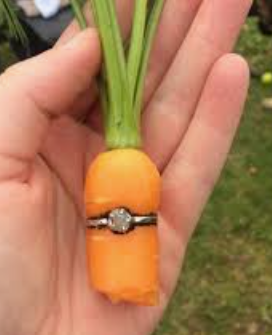
The story of the carrot and the ring
Have you ever lost something that was precious to you, and thought you’d never see it again? That’s what happened to Mary Grams from Canada.
Mary had worn her engagement ring for more than half a century when she suddenly lost it. She was working in her garden on the family farm one day, pulling out a plant. (37) When she discovered it was missing, she searched everywhere for it for days, before finally giving up.
Mary realised she probably wasn’t going to find the ring again. So she decided not to tell anyone about what had happened, apart from her son. Instead, she thought she would replace it with a much cheaper ring from a jeweller’s. (38) In fact, it was so similar that no-one else in her family even knew her original ring was missing.
But the story has a happy ending. Mary eventually got her engagement ring back – 13 years after it was lost! One day Mary’s daughter-in-law Colleen was working in the same garden where Mary had been all those years ago. (39) . But this time it looked a bit different – because there was a carrot growing right through the middle of it!
As soon as Colleen saw the ring, she knew immediately who the owner was. The farm had been in the family for over 100 years. (40) So when Colleen discovered the story of the lost ring, it became clear there was only one person it could possibly have belonged to, and the ring was returned to Mary.
Mary decided to remove her ring from the carrot and wear it again. So she carefully cut the carrot in half. Then the ring was washed, and Mary put it back on her finger – and it still fitted perfectly!
A She was digging up vegetables there when she discovered the ring.
B And that was probably when the ring came off her finger.
C And only two women had lived there in all that time.
D Luckily, she managed to find another one that looked just like it.